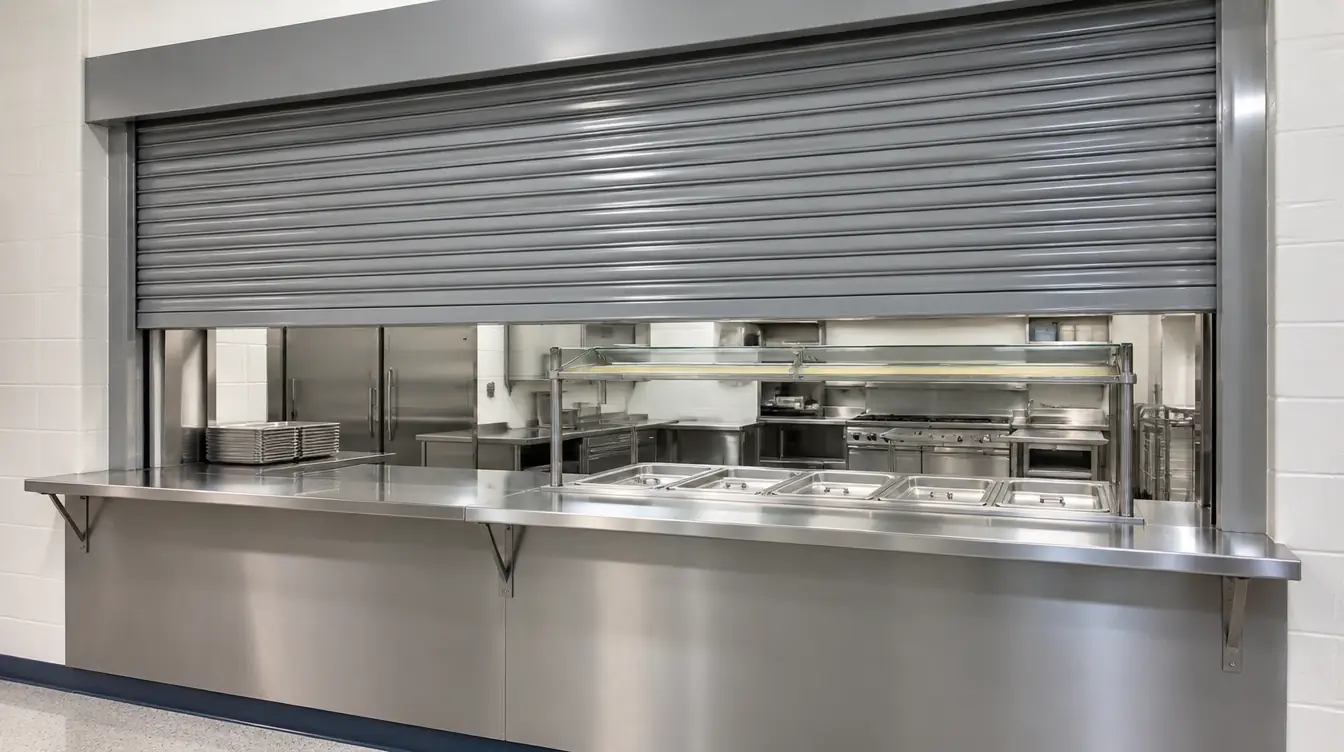
Not always. A serving hatch shutter needs to be fire rated when the hatch is in a wall that is meant to resist fire, such as a wall separating a kitchen from an escape route, dining hall or another fire compartment. In that case the shutter must be a tested fire shutter that closes automatically when the fire alarm sounds or heat is detected. If the wall has no fire-resisting role, a standard security or servery shutter may be enough. Your fire risk assessment and the building design decide which you need.
Serving hatch shutters are everywhere: school canteens, staff restaurants, cafés, bars, hospital kitchens and sports clubs. They secure the counter when the kitchen is closed and keep the area tidy. In many buildings they also play an important role in fire safety, which is why it is worth knowing whether yours needs to be fire rated.
Why kitchens and fire separation go together
Commercial kitchens are one of the most common places for a fire to start. Buildings are often designed so that a fire in the kitchen is kept away from escape routes and the areas where people gather. That means the walls around the kitchen may need to resist fire for a set time. A serving hatch is a large hole in that wall. If the wall needs to be fire resisting, the opening needs a closure that gives the same protection.
When a fire rated shutter is likely to be needed
- the hatch is in a wall between a kitchen and a corridor or escape route;
- the hatch opens into a dining hall, assembly area or other space that forms part of the escape strategy;
- the wall is a compartment wall, separating parts of the building into fire compartments;
- the original building design, fire strategy or building warrant drawings show a fire shutter in that location;
- your fire risk assessment identifies the opening as a weak point.
When a standard shutter may be enough
If the hatch is in a wall that has no fire-resisting role, for example a small café counter in an open-plan unit, a standard aluminium or steel servery shutter may be appropriate. The decision should be based on the building's fire strategy and your fire risk assessment, not just on what is cheaper.
How fire shutters work
- Tested construction. Fire shutters are tested to recognised standards and given a rating for how long they maintain their integrity in a fire. Some also limit heat transfer.
- Automatic closing. They close automatically when the fire alarm activates or when a heat sensor or fusible link is triggered, even if the power fails.
- Controlled descent. They close at a controlled speed so they do not slam onto people or objects.
- Regular testing. They must be maintained and drop tested regularly to prove they will close when needed.
Your legal duties
In Scotland, those responsible for non-domestic premises have duties under the Fire (Scotland) Act 2005 to carry out a fire safety risk assessment and keep fire safety measures, including fire shutters, maintained in good working order. New installations and alterations that affect fire separation may also need a building warrant.
Common problems we find
- a standard shutter fitted where a fire shutter is needed;
- fire shutters disconnected from the alarm or left without power backup;
- shutters wedged or blocked with stock, preventing them closing;
- no record of servicing or drop tests.
Choosing a servery shutter
Whether or not a fire rating is needed, servery shutters should be easy for staff to use every day. Most are manual with a push up handle or crank, while larger or fire-rated shutters are often electric. Aluminium curtains are light and tidy for counters, while fire shutters use tested steel curtains. A good fit at the counter top, smooth running and a secure lock all matter for daily use.
Get your servery shutter checked
We supply, install and service servery and serving hatch shutters for schools, cafés, canteens and commercial kitchens across Glasgow and Paisley, including fire rated options. Tell us about your hatch and we will help you work out what is needed and keep your records in order.
Frequently asked questions
How do I know if my serving hatch needs a fire shutter?
Check your fire risk assessment and building drawings. If the hatch is in a fire-resisting wall, such as between a kitchen and an escape route, a fire rated shutter is likely to be needed.
Do fire shutters close if the power fails?
They should. Fire shutters are designed to close automatically when the alarm sounds or heat is detected, including during a power failure, using battery backup or gravity.
How often should a fire shutter be tested?
Fire shutters should be serviced and drop tested regularly. Follow the manufacturer's guidance and your fire risk assessment, and keep a written record.