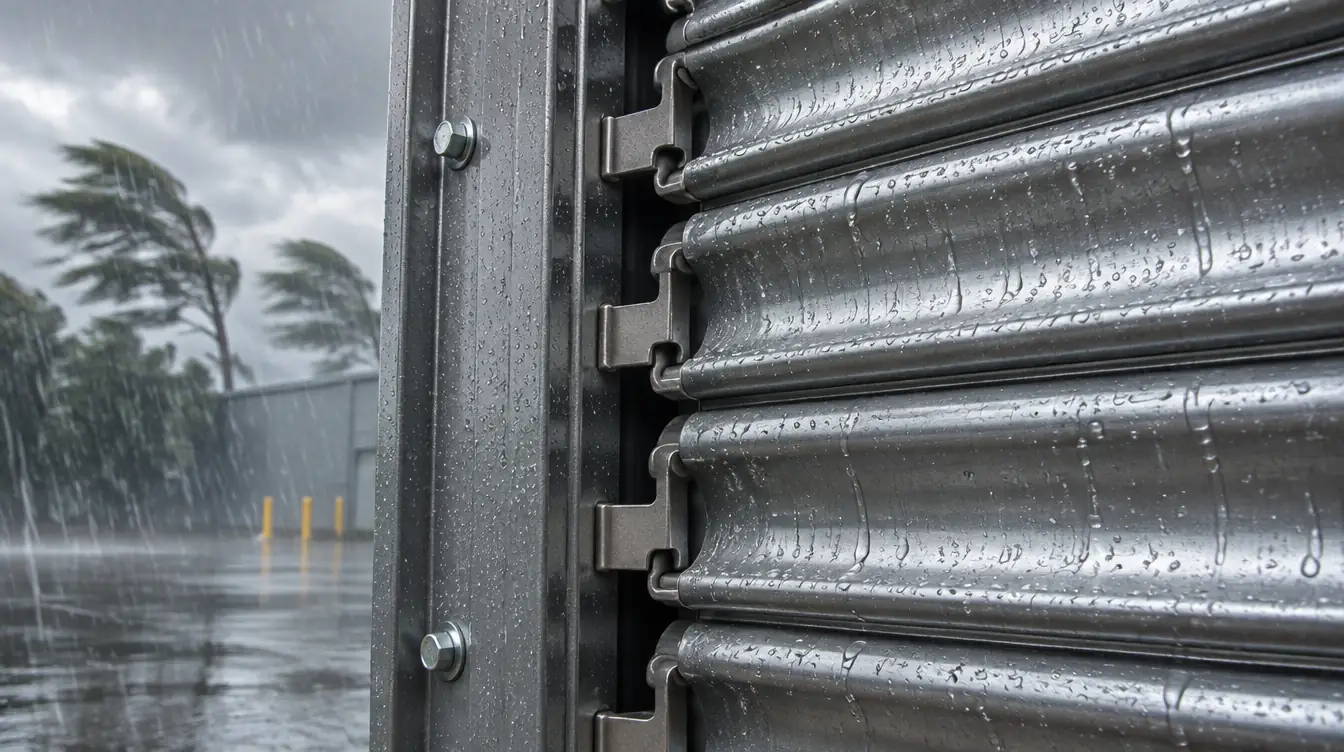
Wind locks are fittings on the ends of a roller shutter's laths that hook into specially shaped guide rails. They stop the curtain bowing and pulling out of the guides when strong wind pushes against it. Small shutters on sheltered shopfronts rarely need them, but wide shutters and doors on exposed sites, such as industrial estates, coastal premises and open riverside units, often do.
Anyone who has watched a large roller shutter bow inwards in a gale will understand why wind matters. A shutter curtain is a big, flat surface. When wind pushes against it, the laths flex, and on wide openings the ends of the curtain can be pulled out of the guide rails. Wind locks are designed to stop that happening.
How wind locks work
On a standard shutter, the ends of the laths sit loosely inside a U-shaped guide rail. That is fine for small openings. On a shutter with wind locks, some or all of the laths have shaped end pieces, often cast or pressed steel, that hook behind a lip inside a deeper, specially designed guide rail. When wind pushes the curtain, the wind locks catch on the rail and hold the curtain in place, so the load is spread across the whole width instead of pulling the ends free.
Why wind is a problem for shutters
- The curtain can be blown out of its guides, leaving the building insecure and the shutter impossible to operate until it is repaired.
- Laths can bend or crease under repeated wind loading.
- The shutter can rattle and bang, which is noisy and wears the curtain and rails.
- Electric shutters can jam if the curtain is distorted as it rolls up.
When are wind locks needed?
Wind loading depends on the size of the shutter and how exposed it is. Wind locks are worth considering when:
- the shutter is wide. The wider the curtain, the more it bows in the middle;
- the building faces open ground, water or a prevailing wind, as many units along the Clyde and on large estates do;
- the shutter is on a tall or elevated building;
- the shutter is an external industrial door that may be left closed through winter storms;
- you have had a curtain blow out of its guides before.
Industrial doors are designed to resist a stated wind load. When we specify a door, we take into account its size and the exposure of the site to decide whether wind locks or a heavier curtain are needed.
Can wind locks be added to an existing shutter?
Sometimes, but it is not always simple. Wind locks need compatible laths and deeper guide rails, so retrofitting usually means changing the guide rails and fitting wind lock end pieces to the curtain. On older or lighter shutters it can be more cost effective to replace the curtain or the whole shutter with a wind-resistant design.
Other ways to reduce wind problems
- A heavier gauge or double skin curtain resists bending better than a light single skin lath.
- Intermediate supports or posts on very wide openings reduce the span.
- Regular servicing to keep guide rails straight and securely fixed.
- Replacing worn end clips, which help keep laths aligned in the guides.
Signs your shutter is struggling in the wind
- the curtain bows noticeably inwards or outwards on windy days;
- you hear banging or rattling in the guide rails during storms;
- the ends of the curtain are scuffed or the end clips are missing;
- the shutter has jammed or come out of its guides before.
If you notice any of these, avoid operating the shutter in very strong wind if you can, and have it inspected.
Exposed site? Let us check your shutter
Scotland's weather is hard on roller shutters, especially on open industrial estates and riverside units in Renfrew, Hillington and along the Clyde. We can assess an existing shutter that has been blown out of its guides, carry out repairs, and recommend wind lock or heavy duty options for new installations.
Frequently asked questions
Do domestic roller shutters need wind locks?
Small domestic window and garage shutters on sheltered sites usually do not. They are mainly needed on wider shutters and exposed sites.
My shutter blew out of its guides. Can it be repaired?
Usually, yes. The curtain is refitted, damaged laths and end clips replaced and the guide rails checked. If it keeps happening, wind locks or a stronger curtain should be considered.
Are wind locks the same as end locks?
Not exactly. End locks or end clips keep the laths aligned and stop them sliding sideways. Wind locks are a stronger type of end fitting designed to hook into the guide rail and resist wind pressure.